Epoxy vs. polyaspartic garage floors in Reno’s climate
The short answer
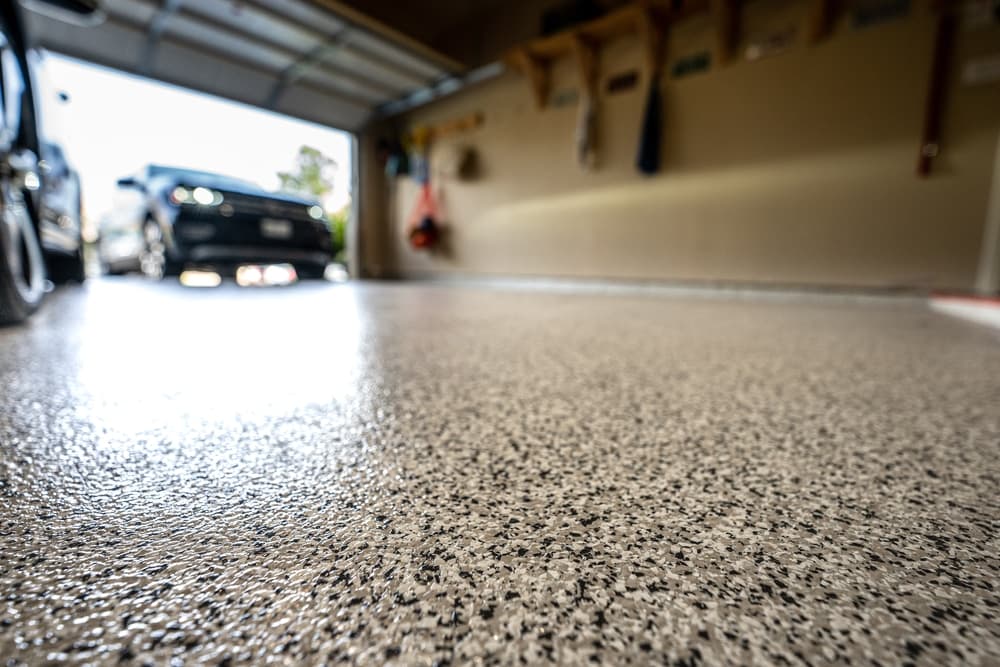
For most Reno and Sparks garages, a polyaspartic topcoat outperforms a straight epoxy floor. Polyaspartic cures in hours, stays clear in direct sun, and flexes through freeze-thaw swings, while epoxy cures slowly and can amber near an open garage door. Battle Born uses a flexible base coat with a polyaspartic topcoat, so you get epoxy-like build with polyaspartic durability in a one-day install.
| Feature | Epoxy | Polyaspartic |
|---|---|---|
| Cure before parking | Several days | About 24 hours |
| Install time | Usually 2 to 3 days | Usually 1 day |
| Sunlight (UV) | Can yellow or amber | Stays clear |
| Freeze-thaw and cold installs | Needs warm slab temps | Cures in a wider temperature range |
| Mag chloride and road salt | Good once fully cured | Excellent |
| Hot-tire pickup | Risk on thin or DIY coats | Highly resistant |
| Best use | Interior decorative and metallic floors | Garages, patios, and sun-exposed slabs |
Why the climate decides this
Reno sits at about 4,500 feet with strong UV, summer slab temperatures over 100 degrees near an open door, and winter nights well below freezing. NDOT spreads magnesium chloride on I-80 and US-395 from late fall into spring, and it rides into the garage on every tire.
A coating here has to bond tightly, stay flexible through big temperature swings, resist chemical brine, and not yellow in sunlight. Those four demands are where epoxy and polyaspartic separate.
Where epoxy still makes sense
Epoxy builds thick, self-levels well, and is the base for decorative metallic floors. Indoors, away from sunlight, it is a strong and cost-conscious choice. That is why our metallic epoxy floors use epoxy for the artistic layer and a protective clear coat on top.
Where epoxy struggles is as the only layer in a sunny, salty garage. It needs days to cure, it can amber in UV, and rolled-on store kits over unground concrete are the most common peeling floors we replace.
Why we top garages with polyaspartic
Polyaspartic is a fast-curing, UV-stable aliphatic coating. It lets us grind, repair, base coat, broadcast flake, and seal in a single visit, and it holds its color next to an open door through Nevada summers.
It also keeps more flexibility in cold weather, which matters when a slab moves through dozens of freeze-thaw cycles each winter.
Prep matters more than the product
Either coating will fail if it sits on top of the slab instead of bonding into it. Every Battle Born floor is diamond-ground with HEPA dust extraction, cracks are filled, and moisture is checked before any coating goes down. That prep, not the label on the can, is what keeps a floor bonded for the 15-year product warranty.
Last reviewed October 26, 2026.